They Changed Ballet Forever: The Rise of the Hiplet Ballerinas on AGT
When the America’s Got Talent audience first saw the Hiplet Ballerinas step onto the stage, many expected traditional ballet: graceful tutus, classical music, and rigid formality. What they got instead was something explosive — a bold fusion of ballet and hip-hop that challenged decades of convention and instantly captured global attention.

Their performance wasn’t just entertainment. It represented a cultural shift in the dance world.
The Hiplet Ballerinas, based in Chicago, were founded through the work of legendary choreographer and dance educator Homer Hans Bryant. Bryant created “Hiplet” — pronounced “hip-lay” — by blending classical ballet technique with hip-hop, African, Latin, and urban dance influences. The style evolved from what he originally called “Rap Ballet” in the 1990s.
What made Hiplet revolutionary was not only the choreography, but the message behind it.
For generations, classical ballet has often been criticized for its lack of diversity and rigid beauty standards. Many young Black dancers struggled to see themselves represented on major ballet stages. Hiplet changed that by embracing dancers of different body types, skin tones, and cultural backgrounds while maintaining the discipline of classical pointe work. The dancers even wore pointe shoes and tights dyed to match their skin tones — a small but powerful symbol of inclusion.
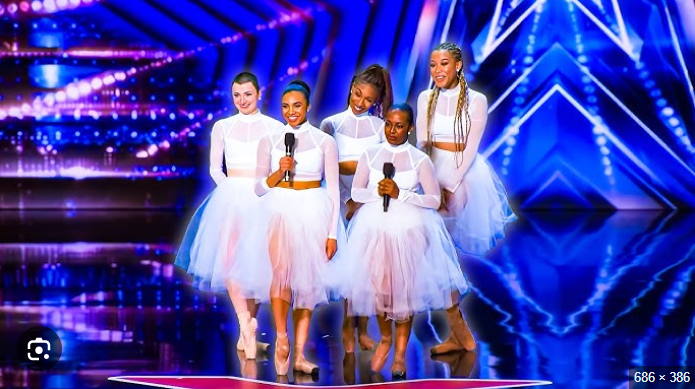
On AGT, the troupe stunned judges and viewers by mixing flawless ballet technique with high-energy hip-hop movement. During the audition, judge Simon Cowell joked that ballet could be “boring,” only for the dancers to completely overturn that stereotype moments later. Their routine combined pirouettes, pointe work, sharp isolations, and rhythmic hip-hop grooves in a way audiences had rarely seen on mainstream television.

The performance quickly went viral online.
What resonated with people was the feeling that ballet was finally becoming accessible to everyone. Hiplet removed the image of ballet as an elite, untouchable art form and transformed it into something modern, expressive, and culturally connected. Bryant himself explained that he wanted ballet to “stay relevant with young people” by connecting it to contemporary music and culture.
The impact extended far beyond television. The Hiplet Ballerinas have since performed internationally, bringing their uniquely American fusion style to audiences across Europe, Asia, and the United States. Critics and fans alike have described the movement as a redefinition of ballet itself — one that respects classical technique while breaking open its traditional boundaries.
Perhaps the most important thing the Hiplet Ballerinas accomplished was inspiring a new generation of dancers who previously felt excluded from ballet culture. Young dancers watching AGT suddenly saw performers who looked like them dancing en pointe to music they actually listened to. That visibility matters.
The Hiplet movement proves that art forms survive by evolving. Ballet did not lose its identity through Hiplet — it gained a new audience, a new energy, and a new future.
For many viewers, the Hiplet Ballerinas weren’t just contestants on AGT.
They were the moment ballet changed forever.